



Words by : Kgomotso Moncho, an arts journalist specializing in theatre, performance and contemporary dance.
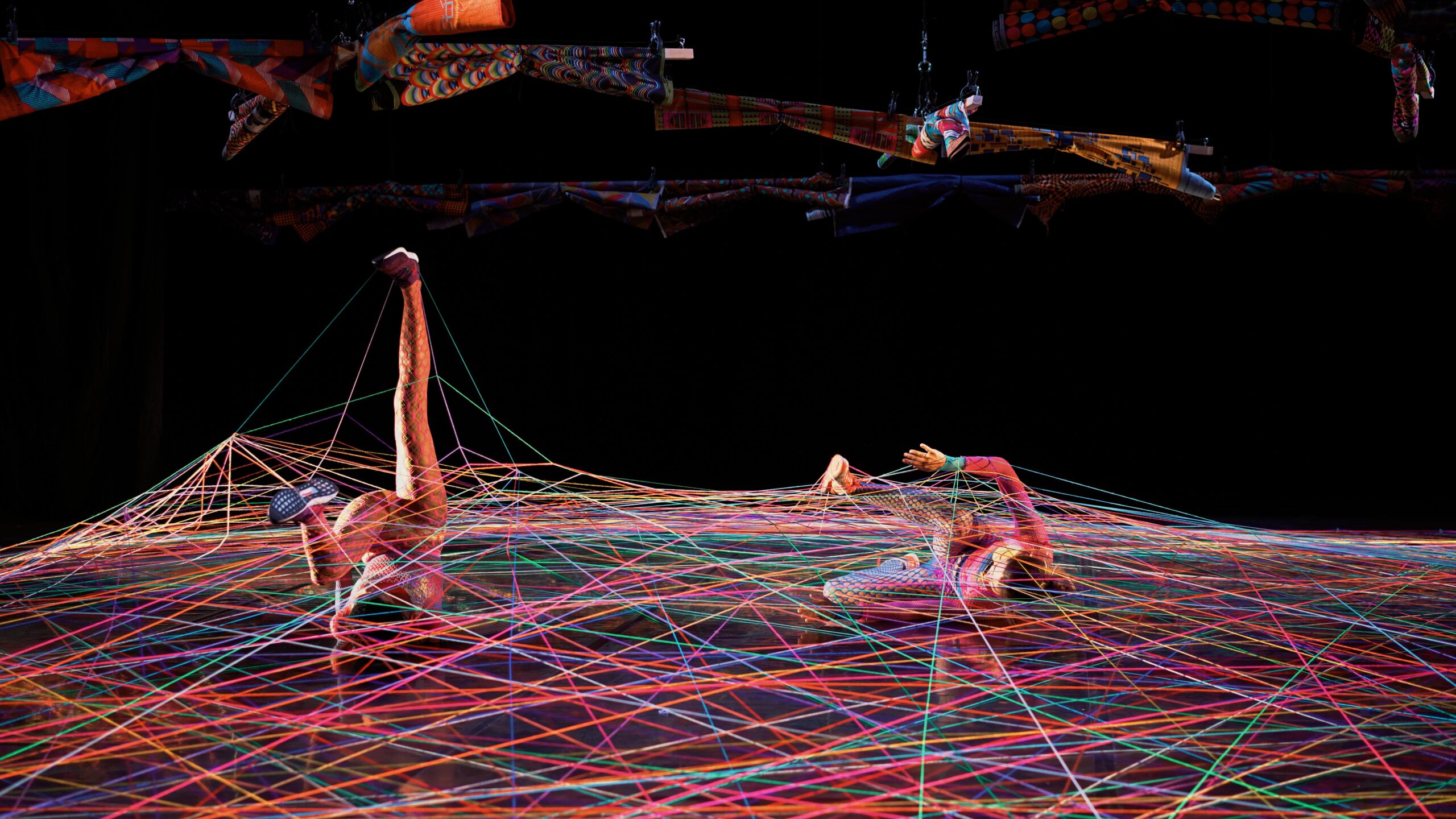
In their signature work, South African choreographer and performance artist Nelisiwe Xaba and Swiss choreographer and dance theatre-maker Marie-Caroline Hominal weave a web of entangled histories, cultures and politics. With threaded wool and hanging textiles, they turn the stage into a woven labyrinth and an installation of cloth. The popping colour is an invitation to a kaleidoscope of ideas. Their movements probe and question. In other sequences – as the artists internalise and move to electronic dance beats – they provide subversive commentary.
The work Hominal / Xaba is a fluid convergence of dance, performance and visual art. Fresh from a performance in Namibia, the production finishes its 2025 Southern Africa tour in Johannesburg this week.
Launched in 2019 and since performed across Switzerland, France, Belgium, South Africa, and Canada, Hominal / Xaba is the result of years of connection and collaboration between the two artists who first met as students at London’s Rambert School of Ballet and Contemporary Dance. They share a knack for daring aesthetics that explore synergies between dance, art, fashion and multimedia.
With her seminal works They Look at Me and That’s All They Think (2006) and Sakhozi Says ‘non’ to the Venus (2008) Xaba uses the story of Sarah Baartman to articulate politics of the black female body in relation to history, gender and race. The former – a collaboration with Carlo Gibson of the designer duo Strangelove – is symbolic of the “exotic voyeurism” Xaba experienced in her Western dance training. As the only dancer to have been represented by a gallery she pioneered avant-garde contemporary dance in SA that taps into technology, performance art and multimedia.
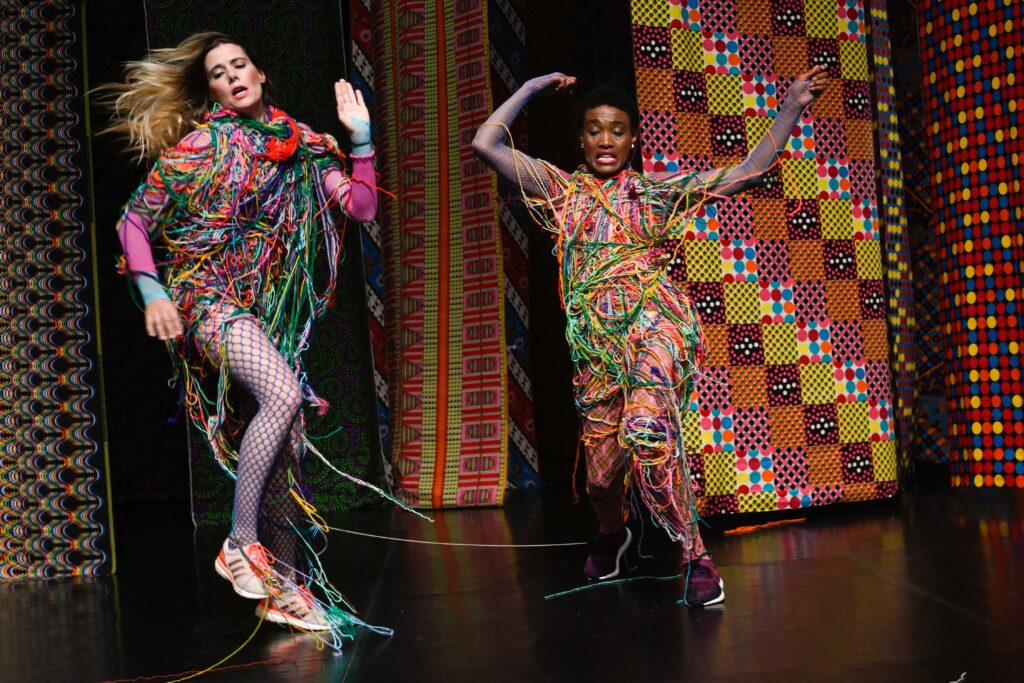
Geneva-based Hominal’s artistic practice spans dance, film and sculpture. Her performances have been presented in museums, galleries and unconventional spaces such as hotel bedrooms and semi-trailer trucks in Europe, China and the Americas. The artists’ partnership brings their shared interests together for a dialogue with local and global contexts.
“We are certainly influenced by where we live and work, but for this work it’s the will to be side by side and share our ideas through colour, dances and dialogues. As dancers we keep travelling and meeting in other places, that’s what makes it global. But to speak with the body is universal,” says Xaba and Hominal.
Hominal / Xaba forms part of the larger Hominal / XXX series created by Hominal in 2015 as a research project into authorship and unexpected artistic pairings. The first in the series is Hominal / Öhrn (2018) a collaboration with theatre director and video artist Markus Öhrn that flips the relationship between choreographer and interpreter. The third is Hominal / Hominal (2023) a collaboration with Hominal’s visual artist brother, David which is a call-and-response between dance and painting.
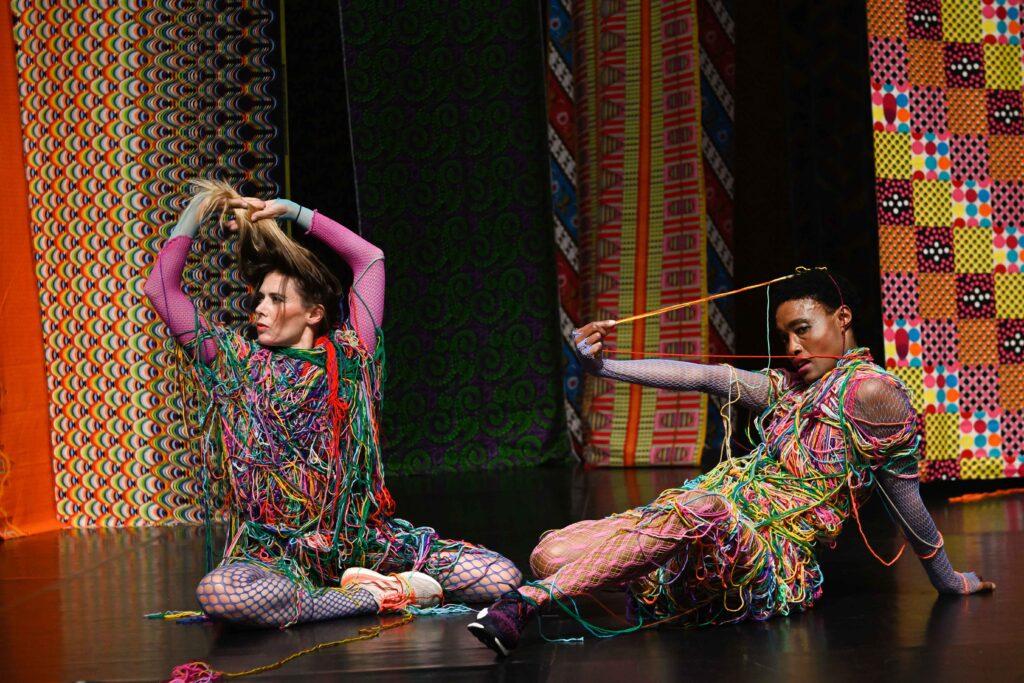
With Hominal / Xaba the two choreographers question authorship, cultural appropriation and bring issues of identity, embodied knowledge and the digital age into focus with playful wit and visual eloquence. The bright and multi-patterned African cloths might conjure thoughts on the colonial origins of iconic South African traditional fabrics – like seshweshwe – which were localised by cultural authentication.
The work’s ownership – attributed to the artists as its authors – becomes blurred and dissolved in its execution.
“The choreographic language was drawn from a third party (scenography and technology) because we wanted to liberate ourselves from the individual choreographic signature. The digital world has influenced the way we think about choreography and authorship, we poke at the politics of copyright,” Xaba says.
Hominal adds, “We worked with texture, material, task and also tutorials to create the choreography. A mix of mediums and elements were used to create the piece.”
Social media has in recent years communised choreography. And the idea of the body as an archive of moving stories also compounds issues of authorship. Hominal / Xaba seems to suggest the dissolution of the author. “1 + 1 equals 3,” says Hominal.
Structurally the work hasn’t changed, but time has nourished its growth.
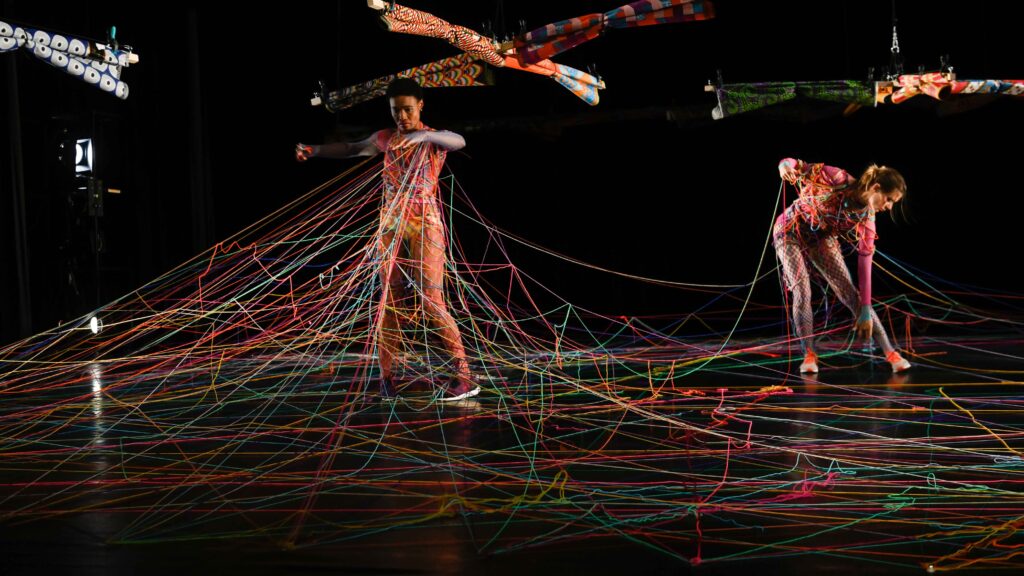
“We have settled inside the piece but the space and distance in between performances keeps it new for us. Each time we come back into the piece we have new interrogations. And we’re more mature and experienced,” the artists say.
What Joburg audiences will see is a fuller version of the piece. While each curtain call speaks to the work’s ephemeral nature, its themes are always in motion. For the artists Hominal / Xaba is an unapologetically abstract manifesto of varied and unifying ideas. With its luring colour and bold creativity, it succeeds in not telling you what to think, but what to think about.
Catch Hominal / Xaba for two nights only at the Wits Theatre on December 10 and 11. Tickets are available at WebTickets.
About Guest Writer:
Kgomotso Moncho-Maripane is an arts journalist with a specialist focus on theatre, performance, and contemporary dance. Her work is grounded in thoughtful cultural critique, rich storytelling, and a deep understanding of South Africa’s creative landscape. As a guest writer for Between 10and5, she brings an informed and nuanced voice to documenting the artists, movements, and narratives shaping the performing arts.